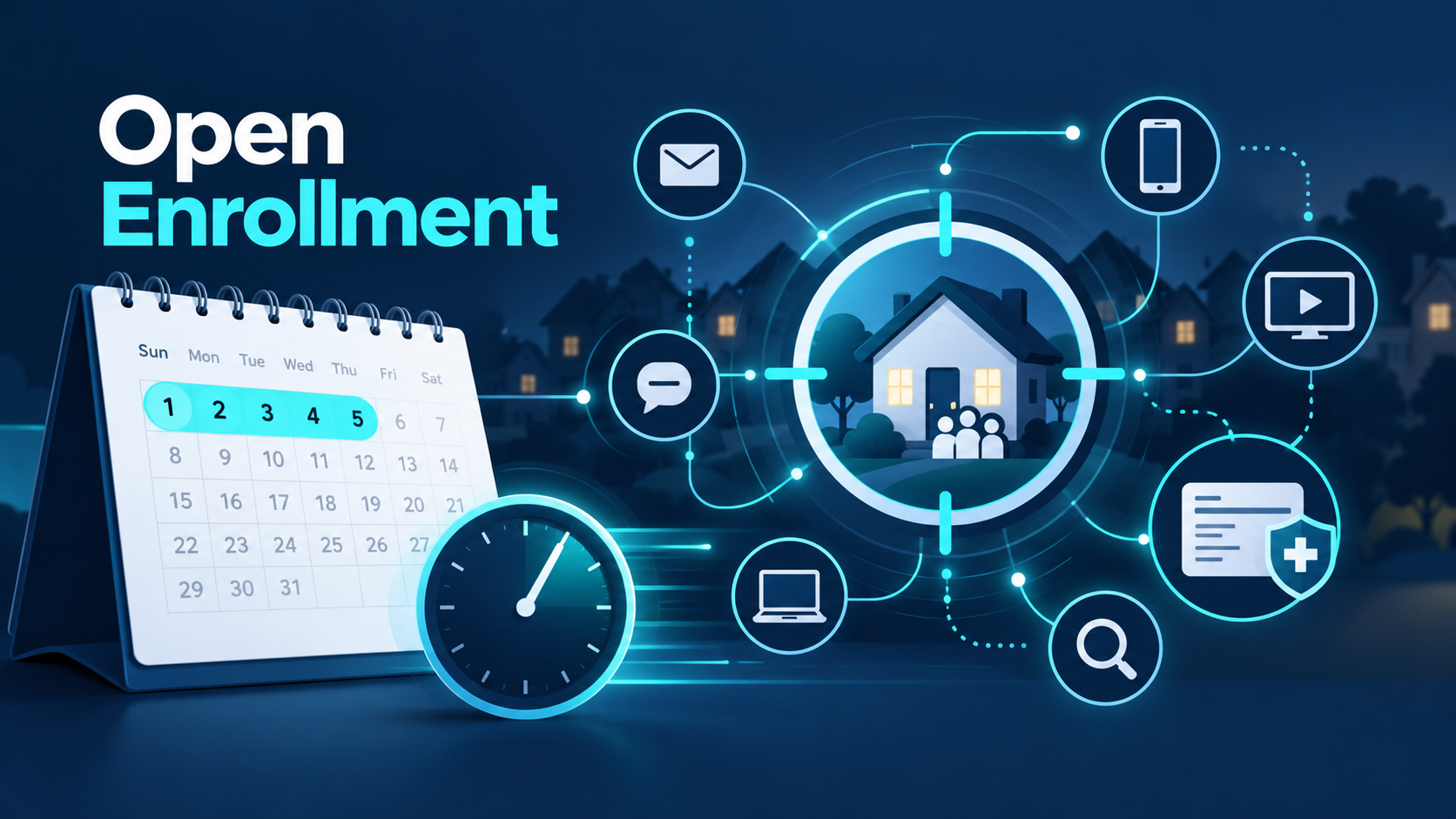
Every fall, health plans, carriers, and the agencies that serve them run the same race. Medicare Annual Enrollment opens October 15 and closes December 7. ACA Open Enrollment opens November 1 and, for 2027 coverage, closes December 15 in HealthCare.gov states, a month earlier than last year. No state exchange can run past December 31. Most of the year’s Medicare and ACA enrollment happens in those few weeks. Miss the window and there is no making it up until next season.
That compression creates a problem most teams do not see until it is already costing them. The targeting is often not ready when the window opens.
The hidden cost
Here is how it plays out. A plan locks its media strategy in October. The first-party list, the lookalikes, the suppression files all go into audience onboarding. With legacy onboarding, that takes five to fourteen days. By the time the audience is live and activated across channels, Medicare AEP has been running for a week or more, and ACA is about to open. The campaign spends its first and most valuable days waiting on data plumbing instead of reaching eligible households.
In Open Enrollment, speed decides the campaign. Every day of onboarding is a day of the window you do not get back.
Why it happens
The delay is structural. Most onboarding moves and re-keys data, matches it against a probabilistic graph, and waits for batch processing and platform sync. The more careful the match, the longer the wait. Teams accept the lag because they assume precision requires it, but it does not have to.
The fix: deterministic and fast
Deterministic identity resolves the tradeoff. At Semcasting, we build an audience from published sources and resolve it through patented constellation matching: IP-to-address, email, and device signals validated against each other rather than inferred from a single guess. Each match resolves to a verified individual and household and carries a confidence score. Match rates run 85 to 87 percent of a first-party file, with 98 percent deterministic accuracy on the matches. Because the match runs against a deterministic graph rather than waiting on cookie syncs, audiences go live the same day on direct integrations and within 48 hours on most others, across CTV, display, video, social, and audio, with direct mail on its own production schedule.
The practical difference: the audience is live in the first days of the window, not the second week.
Precision without PHI
Open Enrollment targeting carries a second concern, and it is a fair one. How do you reach enrollment-eligible households without touching anyone’s health data?
You do not need health data to do it well. OE audiences are built from published CMS and census sources and scored for enrollment fit. A fit score reflects the likelihood of being in market, not anything about any individual’s health. No PHI is used, nothing is cookie-based, and every input is explainable line by line. Five enrollment audiences come from one identity spine: ACA Marketplace, Employer-Sponsored, COBRA, Medicare Advantage, and Medigap.
Prove who you reached
The window closes fast, so you cannot wait until it is over to learn whether the spend worked. Deterministic identity also closes the loop. Ad exposure maps back to the household and into your own CRM, with a fixed household holdout so results read against households that never saw the media. Because the holdout is fixed at the household level, it stays stable across the flight. That is measurement a CFO can follow in time to shift budget while the window is still open.
The window is the whole point
Open Enrollment rewards the team that is ready when the window opens and can prove what worked while there is still time to act. The hidden targeting problem is time. Deterministic identity gives you the one thing the enrollment calendar never will: the whole window.
See the five OE audiences and how they are built, or request a demo.