Match Rate, Issue #3
Identity, data and measurement from someone who runs it.
Wednesday, October 14, 2026 · By Geetha Neelakantiah
This week's lead is about a number every buyer uses and almost nobody checks: reach. Warner Bros. Discovery ran the same campaigns through five measurement vendors and got conflicting answers. Then an update on Apple: one company is unblocked, and the rest aren't.
The two that matter
1. Five measurement vendors, one campaign, reach up to 2.6x apart
What happened
On Oct 6, at Advertising Week New York, Warner Bros. Discovery released a white paper called "The Unified Reach Paradox." WBD compared how five vendors measure cross-platform video (Comscore, Innovid, iSpot, Samba and VideoAmp) and looked at more than 50 of its 2025 campaigns that more than one of them had measured. Nielsen was not included. AdExchanger reports that Nielsen does not allow side-by-side comparisons.
The gaps were large:
- Vendors mostly agree on impressions, but not on reach. Across 48 campaigns that two or more vendors measured, digital impression counts differed by 12% on average. Digital reach differed by 92%, and total cross-platform reach by 39%. (WBD measures this as standard deviation divided by the mean.)
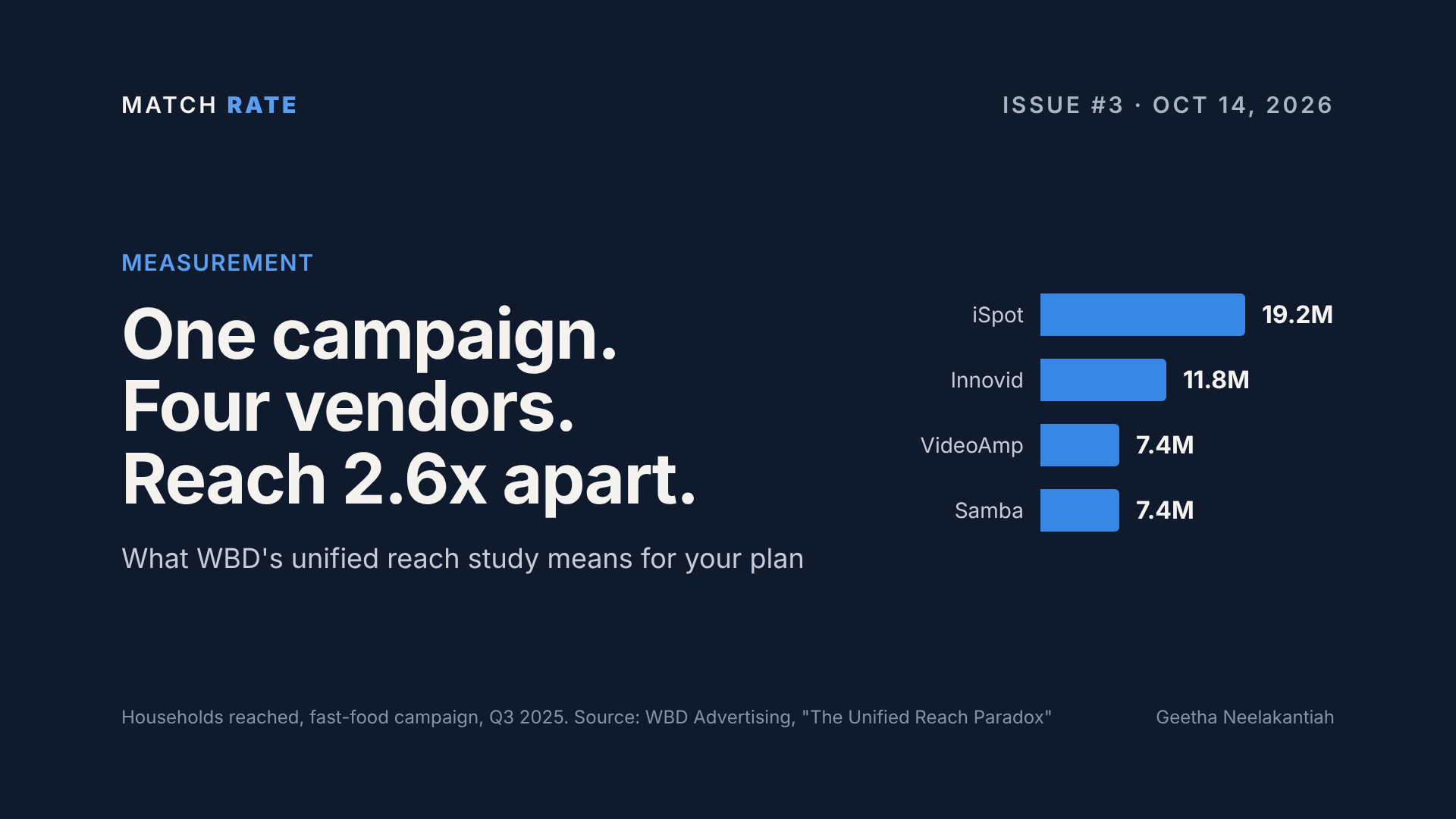
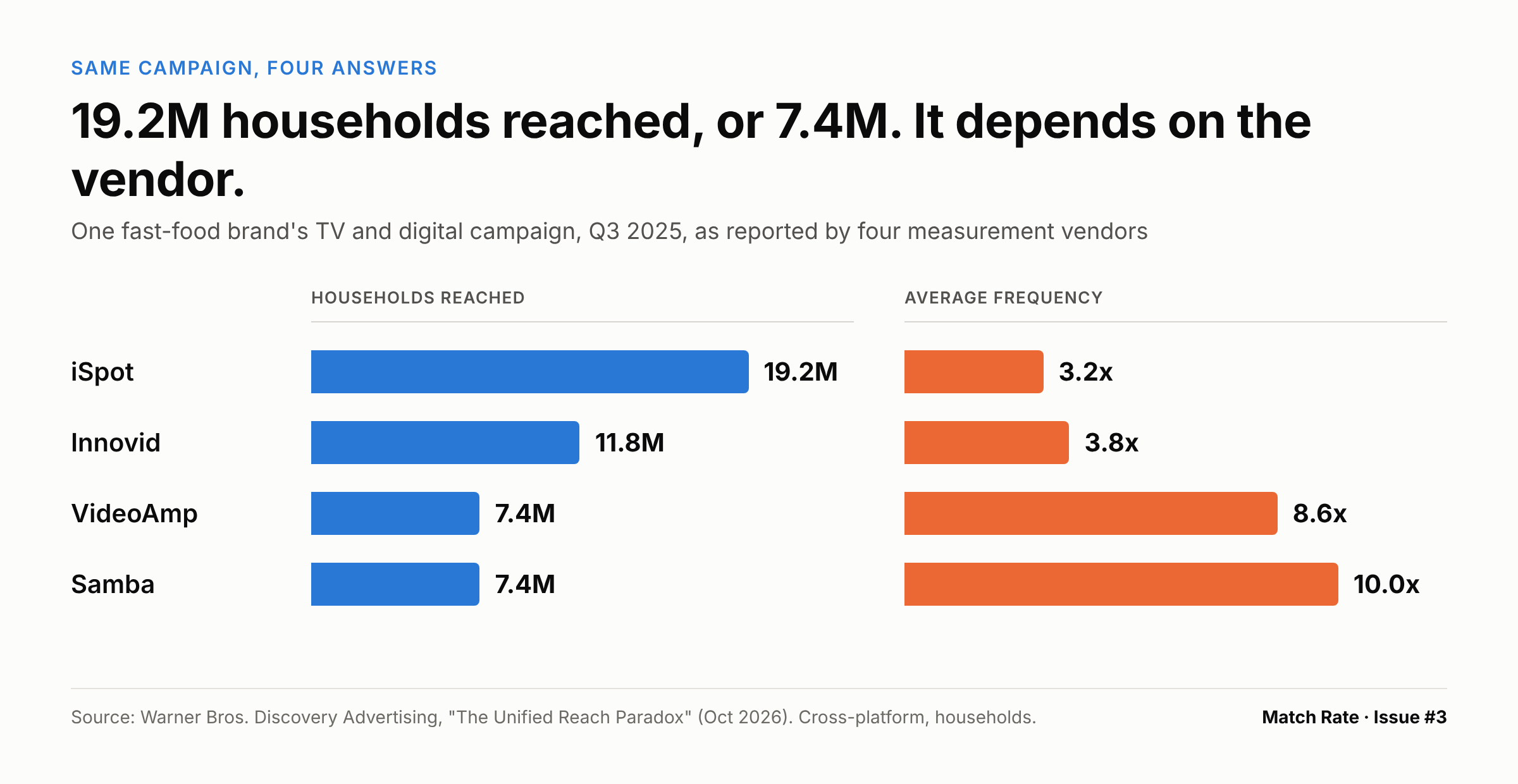
- One campaign, two different stories. For a fast-food brand's Q3 2025 TV and digital campaign, four vendors reported household reach from 7.4 million to 19.2 million. iSpot put the campaign at 19.2 million households seeing the ads about 3 times each. Samba put it at 7.4 million households seeing them about 10 times each. One reads as a broad, efficient campaign. The other reads as a narrow one with heavy frequency.
- Incremental reach. Across all campaigns measured, Innovid and iSpot estimated digital added 43% to 44% household reach on top of TV. Samba and VideoAmp estimated 15% to 18%.
WBD also commissioned a survey of 154 buyers through Advertiser Perceptions. 79% said they can't fully trust campaign results without confidence in unified reach.
WBD names five reasons vendors disagree: universe estimates, identity resolution, how impressions and viewability are counted, which platforms each vendor can see, and how households are turned into demographics. Its finding is that identity resolution "drives the digital swings." One provider's match rate ranged from 5% to 48% depending on the campaign. WBD says the degree of deterministic versus modeled data is one of the factors involved. Universe estimates and impression definitions differed too, but WBD found they had less effect on the results.
Demographics added another layer. In a financial brand's Q4 2025 campaign aimed at adults 25 to 54, Comscore counted 43.5 million impressions and iSpot counted 24.6 million, mostly because of linear TV. Comscore assumes about 0.61 adults 25 to 54 watching per household on linear. iSpot assumes 0.42 and VideoAmp 0.37.
What it changes
Counting impressions is mostly a solved problem on digital. Reach isn't counted. It's inferred. To say how many households saw an ad, a vendor first has to decide which devices and impressions belong to which household. Where it can't match an impression, it models. A vendor whose match rate swings between 5% and 48% from one campaign to the next is modeling most of the answer on some campaigns and little of it on others, and the buyer usually can't tell which.
That carries into everything built on reach. Frequency caps, reach guarantees, cost per reached household, and the case for adding CTV to a TV plan all depend on which vendor you picked. "Digital added 15%" and "digital added 43%" lead to very different CTV budgets.
WBD is careful on one point, and I agree: the highest reach number isn't automatically the most accurate, and the lowest isn't automatically wrong. A reach number without its inputs just isn't something you can plan on.
One more caution: WBD sells the inventory being measured, so it has a stake in how reach gets counted. Its recommendations are reasonable: common rules for the basics, disclosed methods, and new guidance on identity resolution and match keys. The last one, giving vendors direct access to publishers' impression logs, also suits WBD.
What to do this week
- Ask each measurement vendor what share of your campaign's impressions it matched to a household or person. Ask for your campaign's number, not a general one.
- Ask what universe estimate it used (the total number of TV households or people) and where that number comes from.
- Ask how it counts an impression and a viewable impression on each platform in your plan.
- Don't compare reach across vendors. Pick one for planning and use a second to check direction, not to settle the number.
- Add these questions to your next RFP and ask for the answers in writing.
My bias
Semcasting resolves identity to the household, and WBD names identity resolution as what drives the digital swings. That's our business, so read my take with that in mind. Better matching narrows one of the five sources of difference. It doesn't fix platform coverage or demographic assumptions, and I wouldn't claim otherwise.
Sources: WBD Advertising, "The Unified Reach Paradox" · AdExchanger
2. Apple: The Trade Desk is fixed in beta. The identity providers are not.
What happened
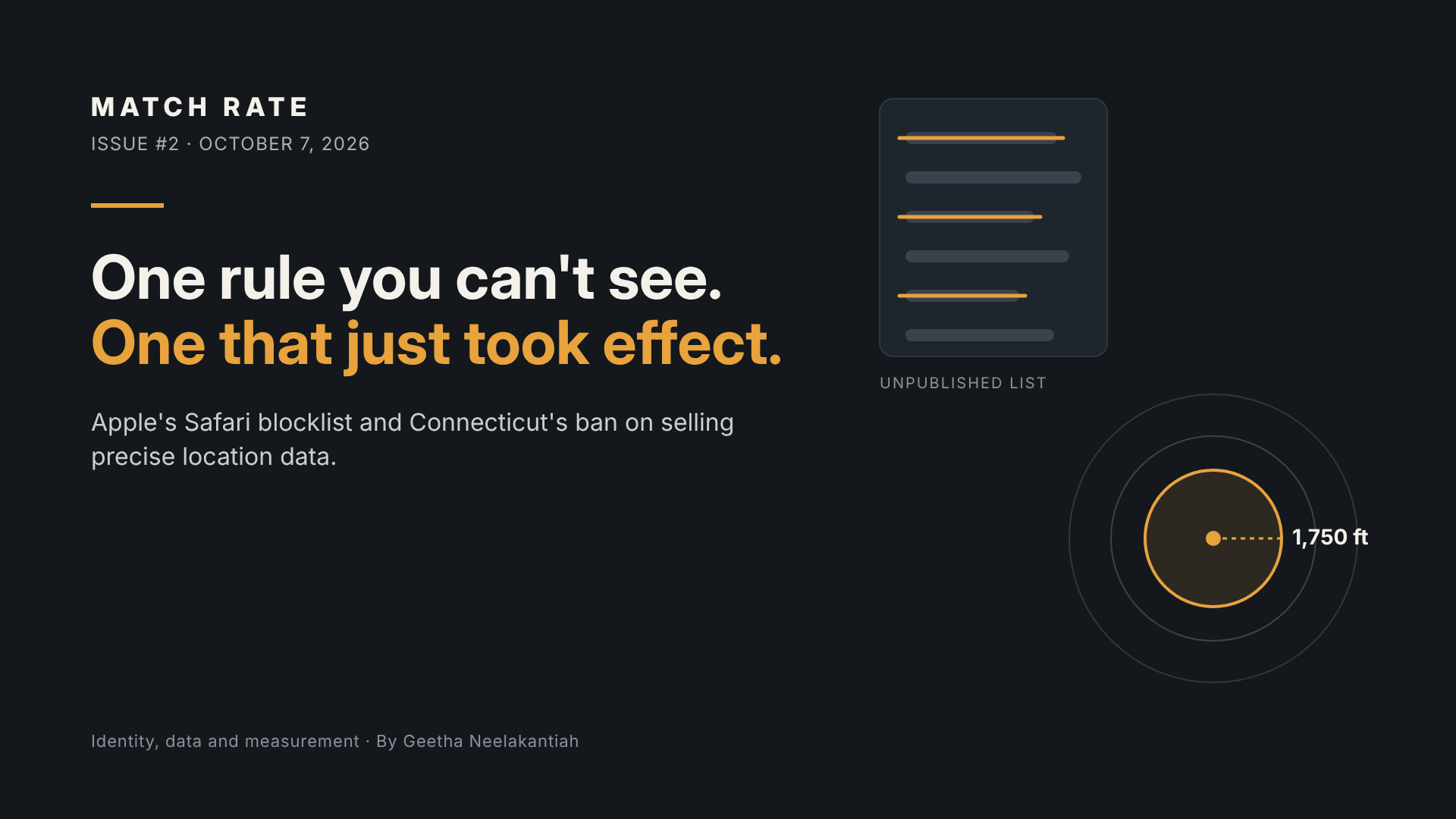
On Oct 9, Apple's John Wilander marked the WebKit bug The Trade Desk filed as "Confirmed resolved," after The Trade Desk tested the iOS 27.2 beta. AdExchanger reports the beta removes The Trade Desk's ad domain (adsrvr.org) from Safari's blocklist. It also reports the block seems to have been aimed at The Trade Desk's cookie sync address (match.adsrvr.org), but Safari blocks whole domains, so the ad server went down with it.
The fix isn't live. iPhones on the current iOS 27 still block The Trade Desk in Safari. Digiday says the fix won't reach users until the end of the month at the earliest. AdExchanger estimates three to four weeks. Apple hasn't given a date.
Nothing public shows a change for the other names on the list: UID2, ID5, LiveRamp, Permutive and Audigent. A Digiday test of more than 70 ad tech domains found only that first group blocked. Lotame, Yahoo ConnectID and Zeta's LiveIntent were not.
A correction to Issue #2
Last week I wrote, citing AdExchanger, that Safari checks a list Apple can update remotely. Digiday reports that Apple has written the code to do that, but the code hasn't shipped. So today, changing the list still takes a software update. That could change in any update, but it's not how Safari works right now.
What it changes
"Apple fixed it" is what most people will hear, and it's only partly true. The fix restores ad delivery for one DSP, in a beta. It doesn't restore the identity layer that cross-channel matching and measurement rely on. Publishers are also reporting lower bids on Safari traffic, and many are now asking IAB Tech Lab about Trusted Server, which moves ad calls onto servers the publisher controls.
There's also a billing question. AdExchanger reports that some advertisers paid for iOS 27 impressions that never rendered. Whether that money comes back depends on the contracts between publisher, SSP, DSP and advertiser.
What to do this week
- If you buy through The Trade Desk, keep treating Safari reach as lost until iOS 27.2 is public and adopted.
- If your measurement or onboarding uses UID2, ID5, LiveRamp or Permutive in Safari, ask the vendor what's working today and what's routed around the block.
- Ask your DSP and publishers whether you were billed for iOS 27 Safari impressions that didn't render, and since when.
Sources: WebKit bug 324771 · AdExchanger · Digiday on Advertising Week · Digiday on Trusted Server
Quick hits
Google and the DOJ agree on most ad tech remedies but not the timing. Judge Leonie Brinkema didn't order Google to sell AdX. Instead she ordered rule changes. Both sides now agree AdX must connect to Prebid and take bids from rival ad servers, and that publishers can export their ad server and bid data. They disagree on timing: the DOJ wants AdX open to Prebid in six months and Google wants twelve, plus up to 24 more months outside the US. The judge decides, then a 60-day clock starts. Google is expected to appeal. Separately, Prebid has proposed reversing its auction so Google's ad server bids into Prebid. That would separate AdX from Google's ad server, which the court declined to order. The proposal is open for comment, and it's not clear Google will take part. AdExchanger · AdExchanger · PPC Land
San Diego County sues AppLovin over ads shown to children. The county alleges AppLovin served sex, gambling and cannabis ads on devices set up for kids, removed a tool developers used to flag users under 13, and designed ads that produce accidental clicks. It's seeking up to $2,500 per violation and refunds to advertisers billed for those clicks. These are allegations. AppLovin hasn't responded publicly to the suit, and it has said before that its SDK doesn't create persistent IDs when users opt out. PPC Land
Norway fines Xandr $9.6M over Grindr data. Norway's data protection authority fined Microsoft's Xandr 92 million kroner, its largest fine yet, for passing Grindr users' data, which revealed sexual orientation, through real-time bidding from 2018 to 2020. Xandr argued that getting consent was Grindr's job. The regulator said each company has to check and document its own legal basis, and that responsibility "cannot be passed on to others." Xandr has three weeks to appeal. Reuters via TradingView · PPC Land
The explainer: where reach numbers come from
Every cross-platform reach number goes through the same five steps. A vendor can make a different choice at each one. Here is what WBD found at each step.
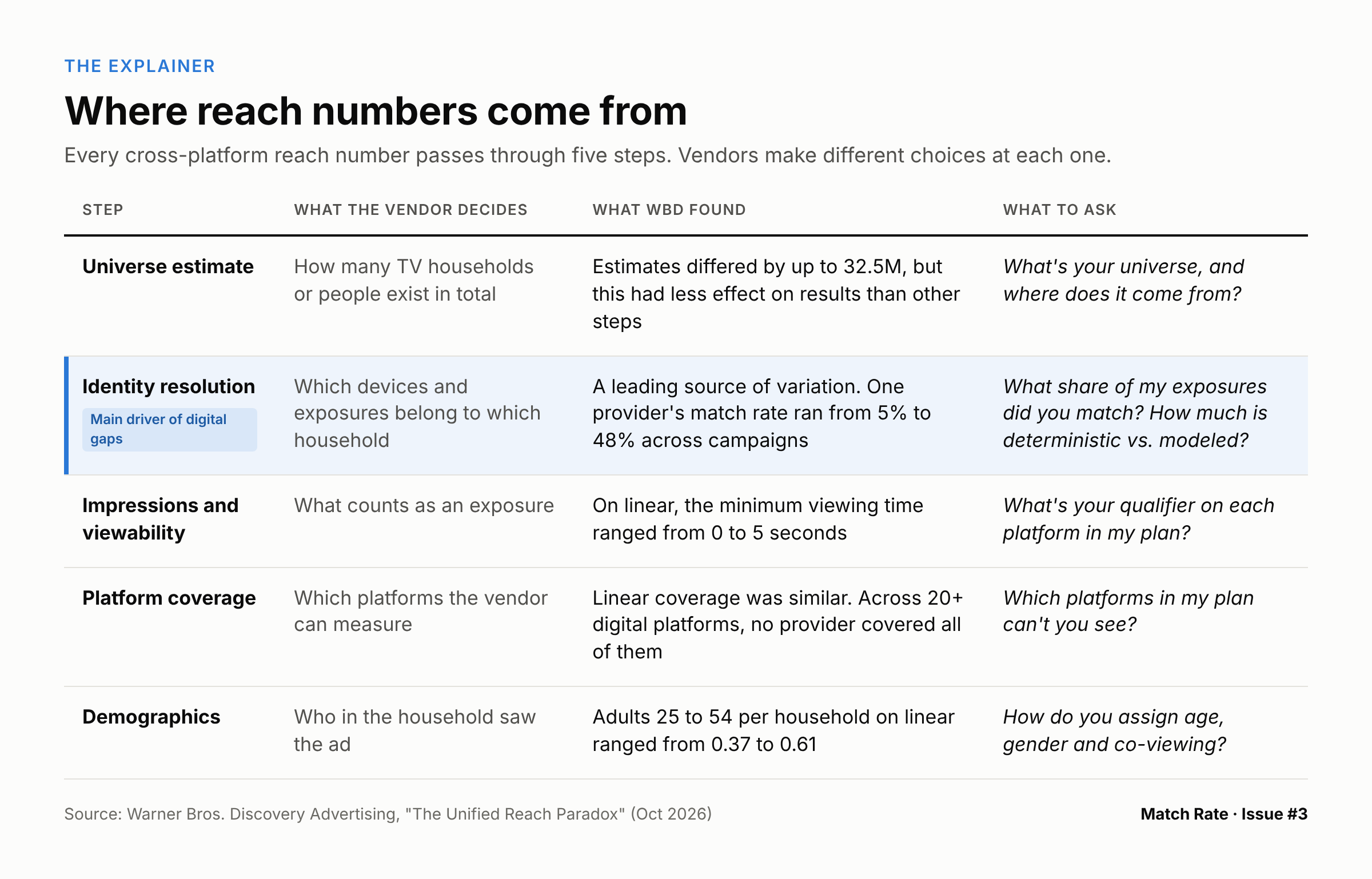
The short version: impressions are counted. Reach is inferred. The less a vendor can match, the more of the number is inference. In WBD's words, variation "is a signal that the number needs context."
The Semcasting Angle: political and advocacy
This section reflects my company's view. Everything above it is vendor-neutral.
In Issue #1 I promised a political spotlight. The midterms are Nov 3, three weeks out, and PPC Land reports midterm ad spending has already passed the 2024 presidential race. When local TV gets this expensive, every impression that reaches someone outside the district, or someone who isn't registered, costs a campaign money it could have spent on persuasion.
Here is what we offer, as published on our website:
- Voter file data. Built from state voter records, not cookies or modeled proxies, with 154 million-plus voters who participated in 2024.
- Onboarding your own lists. Campaigns and advocacy groups can upload their own voter files, CRM exports or supporter lists using postal addresses, emails or phone numbers, and we match them to the same household identities.
- District targeting. All 435 congressional districts, plus state senate and state house districts, down to precinct.
- Matching. Registered voters matched to home IP, mobile devices, CTV households and hashed email. We publish an 85%-plus cross-platform match rate.
- Measurement. Matchback that ties exposure to the target voter list, and next-day reporting on who you've reached and who's left.
- Compliance. FEC compliance documentation and an audit trail of targeting, audience definitions and data sources with every campaign.
A note on that 85% figure, since this issue is about match rates: it measures something different from the 5% to 48% in WBD's study. Ours is how many voter file records we can tie to a digital identity. WBD's is one measurement provider's match rate on campaign exposures. They aren't comparable, and anyone quoting a match rate to you should say what was matched to what.
What to ask any political data partner
- Is the audience built from the voter file, or modeled from consumer data?
- What share of the voter list do you reach on each channel, and how do you check it?
- What documentation do you provide for compliance review?
Our political and advocacy page is at semcasting.com/politics.
A question worth asking this week
"Our measurement vendor says it matched 30% of our impressions. Is that low?"
It depends on what was matched to what, and on the campaign. In WBD's study, one measurement provider's match rate ran from 5% to 48% across campaigns, so a single number doesn't tell you much on its own. The more useful question is what the vendor does with the other 70%.
A low match rate isn't automatically bad if the vendor tells you how it projects the rest and the matched sample looks like your full audience. It becomes a problem when the matched share skews toward certain devices, platforms or households, and the projection assumes the rest look the same.
So ask three things: matched to what (a household, a person, a device)? How are the unmatched impressions projected? And does the matched share differ by platform? For example, if CTV matches at 45% and mobile web at 8%, your cross-platform reach is mostly a CTV number with an estimate attached.
My bias: identity matching is what Semcasting does. The questions apply to us too.
That's Issue #3. If you've lined up two measurement vendors on the same campaign and seen a gap, hit reply. I'd like to hear how big it was.
Geetha
Match Rate is written by Geetha Neelakantiah, SVP Business Development, Marketing & Operations at Semcasting. The views are my own. Sections labeled "The Semcasting Angle" reflect my company's perspective. Nothing here is legal advice.