Identity, data and measurement from someone who runs it.
Publicis now owns LiveRamp. The deal closed on Nov 2, and the rules that come with it are in writing. Most coverage has focused on what those rules protect. This week I read what they leave out, and it changes the question for anyone buying through an agency that isn't Publicis.
The two that matter
1. Publicis owns LiveRamp. Read the part of the order about new products.
What happened
Publicis closed its $2.2 billion all-cash purchase of LiveRamp on Monday, Nov 2, two weeks after the FTC announced a proposed consent order (covered in Issue #5). LiveRamp keeps its brand and its CEO, Scott Howe, and Publicis says it will run it as an independent company. Arthur Sadoun told Adweek that rival agencies are welcome "with open arms." Publicis's chief strategy officer, Carla Serrano, said LiveRamp "will stay open to every brand, every platform, and yes, every agency."
The pitch to clients is a single stack: LiveRamp for onboarding and data collaboration, Epsilon for identity, Publicis Sapient for technology and Marcel for activation. Sadoun's framing is that clients are "trapped between two bad options," walled gardens and consultants, and Publicis is the third.
What the order doesn't cover
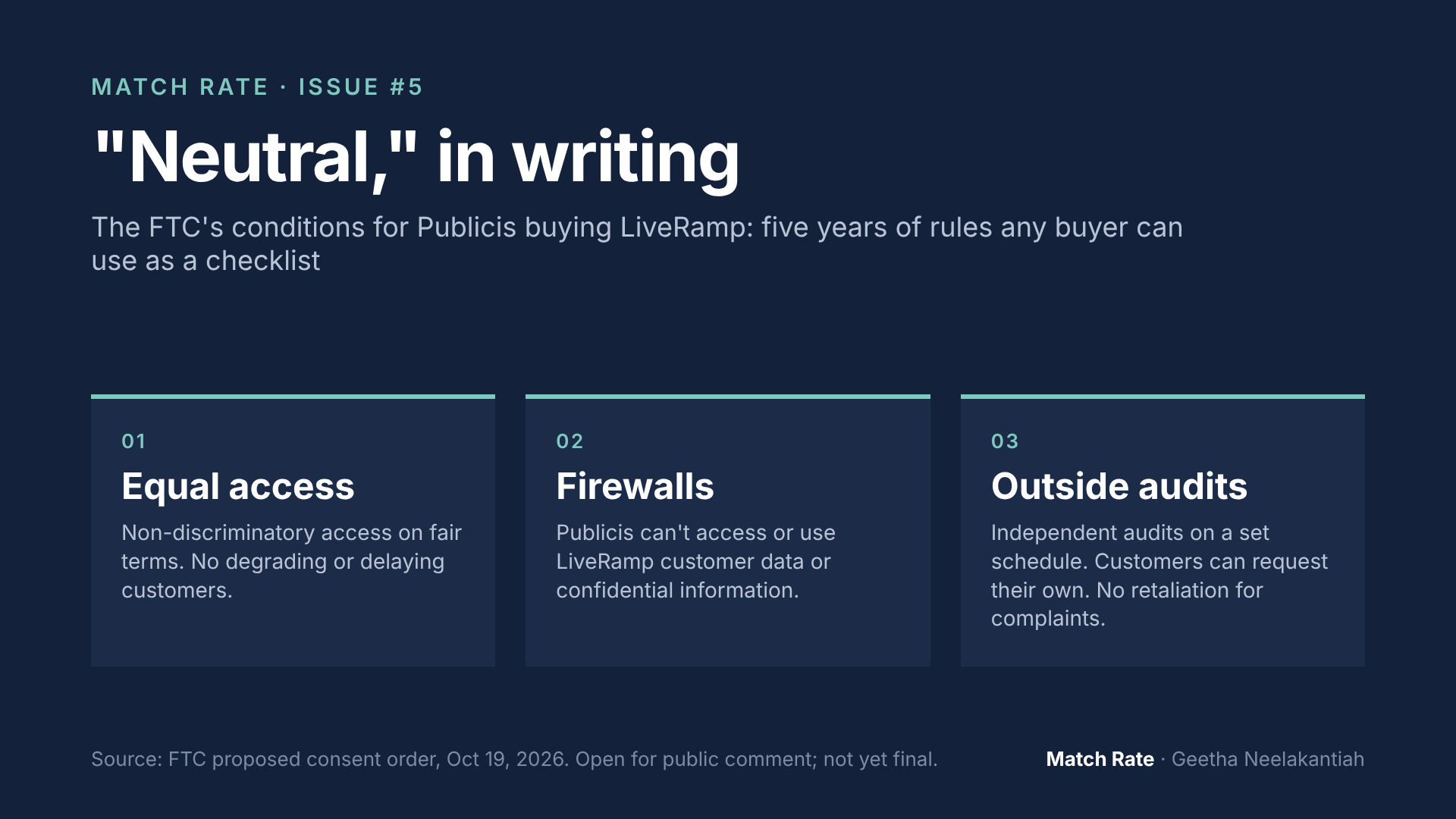
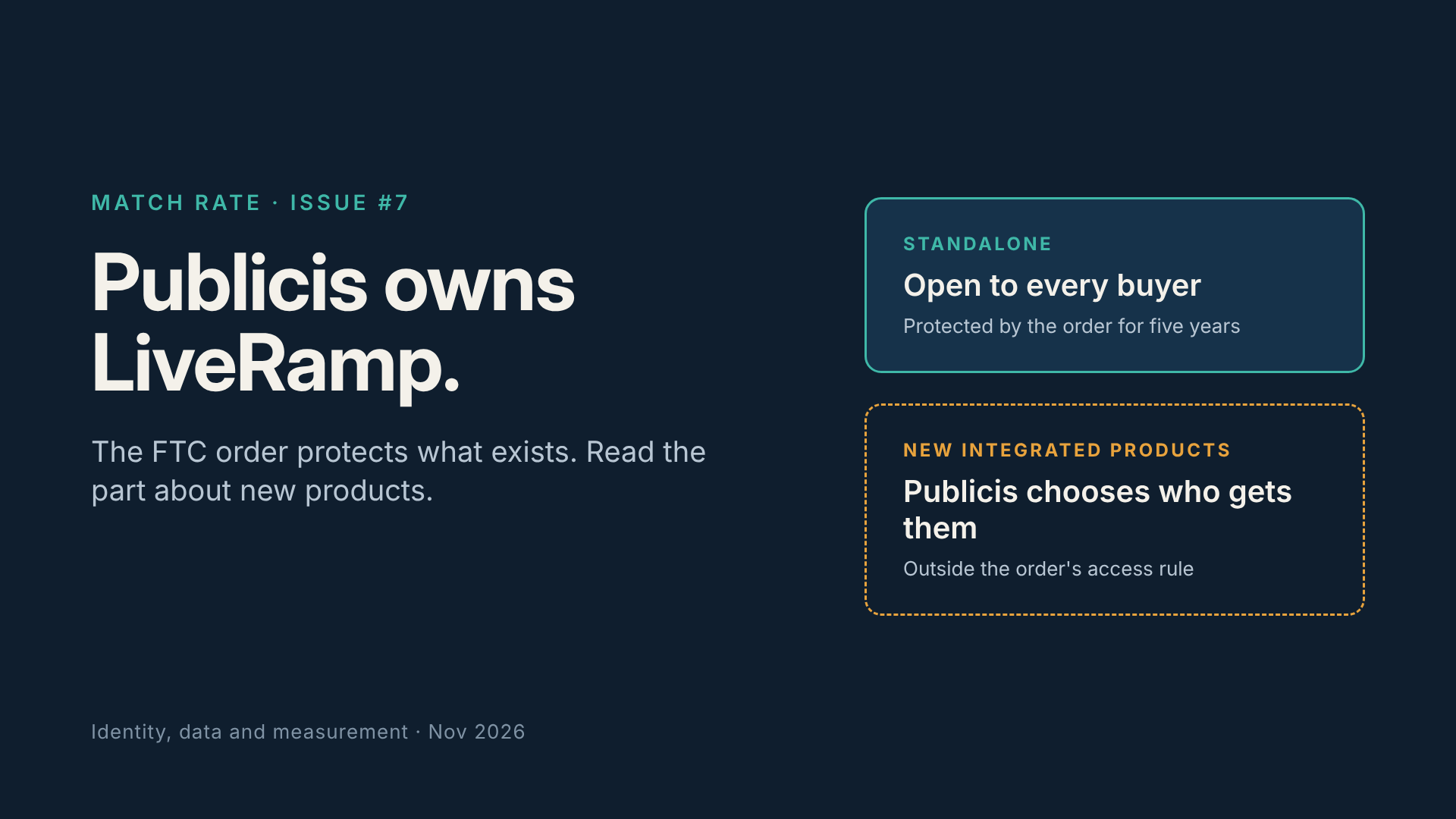
Issue #5 walked through what the FTC requires for five years: equal access to LiveRamp's standalone products, firewalls around customer data, outside audits, and no retaliation. One clause got less attention. Section II.D of the proposed order says the access rule "does not prohibit Publicis from developing with LiveRamp new products and services that integrate LiveRamp products and services with the products and services of Publicis." And: "Publicis will be free to choose to which customers it will offer such new integrated products and services."
So there are two LiveRamps now. The standalone one, which every agency can buy on fair terms for five years. And whatever Publicis builds by combining LiveRamp with Epsilon and its own tools, which it can keep for its own clients. The order doesn't define which products count as "standalone." That line will be drawn in practice, product by product.
What it changes
None of this is hidden or improper. The FTC wrote it down and Publicis has been clear about the one-stack strategy. But it means the useful question for non-Publicis buyers isn't "Is LiveRamp still open?" It is. The question is whether the version you get will keep up with the version Publicis clients get.
The market is already splitting. Omnicom moved its LiveRamp exit forward in May and is building its own identity product, Real ID, through Acxiom. CEO John Wren said he "moved that drop dead date" to a year out. WPP is winding down its agencies' use of LiveRamp and promoting its own data collaboration platform, InfoSum. Havas says it will keep using LiveRamp in North America.
There's a fair case for staying. Digiday's rundown on Nov 4 put it plainly: switching identity partners is expensive and slow, LiveRamp has a large dataset and strong retail media partnerships, and the FTC rules have audits behind them. The case against is just as plain. If Omnicom and WPP clients leave, the graph gets smaller. And 95% of LiveRamp's revenue is in the US, so international advertisers get the neutrality question with less of the benefit.
The Semcasting view (my company's perspective): Semcasting is an independent identity and audience data company with no agency parent, so we gain when buyers worry about this. Read this section with that in mind.
What to do this week
- If you use LiveRamp through a non-Publicis agency, ask your LiveRamp contact which products count as standalone under the order, in writing.
- Ask your agency what its plan is for the next two years, and what happens to your onboarded data and RampID-based audiences if it changes partners.
- If you're considering a switch, run a match test against your own customer file with any replacement before you commit. Match rates vary a lot by provider and by file.
- Watch the first audit. The FTC requires one every six months for the first two years. Public comments on the proposed order are due around Nov 18.
Sources: Adweek, Nov 2 · FTC proposed order (PDF) · FTC, Oct 19 · Digiday, Nov 4 · Digiday on Omnicom, May 20 · DesignRush, Nov 3
2. Search money is moving to places that are harder to measure
What happened
After Alphabet said AI Mode is earning less than regular search (Issue #6), Digiday asked 18 media buyers what they're doing about it. Some are moving part of their Google search budget elsewhere. Power Digital's Bryce Hamlin sees "10% to 30% of the Google search budget getting reallocated" when clients raise it. Accuracast's Farhad Divecha says about 10% now, possibly 20% to 30% around Black Friday. The money is going to Meta, TikTok, Local Services Ads and ChatGPT. Jellyfish says most of the shift is still within Google: AI Max, Performance Max, YouTube.
The same week, The Information reported that OpenAI signed Magnite and PubMatic to sell unused ChatGPT ad space. Both have since confirmed it on their earnings calls. Magnite CEO Michael Barrett: "We are one of their partners, and we are working in the capacity of an SSP piping in demand into the OpenAI advertising inventory." PubMatic CEO Rajeev Goel: "we recently partnered with OpenAI." Advertisers set budgets and bids in those platforms while OpenAI controls placement. That makes five ways to buy ChatGPT ads: OpenAI's own Ads Manager, Criteo, Amazon DSP, Magnite and PubMatic. Neither company disclosed terms.
Early performance data is thin. A working paper by Maximilian Kaiser and Christian Schulze, still under review and based on ecommerce sites, puts ChatGPT ad revenue at $0.89 per session against $2.45 for Google, and paid conversion at 0.37% against 1.17%. Divecha told Digiday tracking discrepancies persist in the new programmatic routes.
What it changes
Search is the channel most brands measure best: a query, a click, a sale. Rebalancing away from it after Google's own comments is reasonable. But the destinations come with weaker or platform-only measurement, and one paper's numbers shouldn't decide anything in either direction. The risk isn't testing ChatGPT. It's moving budget without a way to tell whether it worked.
Publishers are feeling the other side. People Inc. said its Google search referrals are down 70% over two years. Reddit started testing ads in its own search results. Both are building revenue they control instead of waiting for the clicks to come back.
What to do this week
- Before moving search budget, set up a holdout or geo test for the destination channel.
- Report AI placements separately from search and social.
- Write down in advance what result would send the money back.
Sources: Digiday, Nov 2 · Shopifreaks, Nov 4 · Digiday, Nov 5 · AdExchanger on People Inc., Nov 3 · TechCrunch on Reddit, Nov 3 · PPC Land on Magnite's call · PubMatic Q3 transcript (Fool)
Quick hits
Correction: Meta's new terms won't take effect Nov 20. Issue #5's opt-out table listed Meta's commercial terms changes for Nov 20. On Nov 5, Meta paused them indefinitely. Its help center now says the updates "will not take effect on November 20, 2026" and "our existing terms remain in effect." That covers the commercial terms, product catalog terms, self-serve ad terms and generative AI creative terms. Courts in Norway and Brazil had issued preliminary injunctions and the UK's CMA had opened an investigation. Nothing to opt out of for now. One separate Meta change was not paused: the Pixel's "measure conversions on customer devices" setting was scheduled to turn on by default on Nov 12. Check Events Manager to see whether it's on for your datasets, and compare conversions before and after Nov 12 before you read anything into a jump. Nieman Lab, Nov 5 · PPC Land, Nov 8 · PPC Land on the Pixel, Oct 27
The Trade Desk beat its own forecast and pitched itself as the referee. Q3 revenue was $736 million, essentially flat with a year ago and well above its guidance of at least $650 million, and the stock jumped after the report. CEO Jeff Green: "Unlike the walled gardens of Amazon and Google and other user-generated content platforms, we are not grading our own homework." TTD says an open measurement framework that credits more than the last click or view launches later this quarter, and that advertisers can now use first- and third-party data to target Netflix audiences through Kokai. iOS 27.2 is now public. In October an Apple WebKit engineer marked The Trade Desk's bug report "resolved" in a 27.2 beta, but Apple hasn't said whether the public release unblocks adsrvr.org, and it didn't come up in the call coverage I read. Fool transcript, Nov 10 · The Trade Desk on Netflix · 9to5Mac, Nov 10 · MarTech Edition on the WebKit bug, Oct 10
Amazon now sells other retailers' shoppers. Attain's purchase-based audiences are now available inside Amazon DSP, so advertisers can target Amazon users who also shop at Walmart, Kroger, Dollar General, Walgreens or Sephora, including on Prime Video. Attain says the data comes from "permissioned consumer spending." Ask what that means before you buy: where the data originates, what people agreed to, and how it's matched. Adweek, Nov 4 · EcomCrew, Nov 5
Some smart TV opt-outs don't stop the traffic. Northeastern University researchers tested 12 TVs covering eight operating systems. Turning off automatic content recognition fully stopped the related traffic on LG, Fire TV, Sony's Google TV and VIDAA. On Vizio, the researchers write, "the opt-out setting has no observable effect" on traffic to one endpoint. On Samsung, ACR-style traffic continued in most opted-out tests of its own streaming service, antenna and HDMI. Most traffic was encrypted, so the researchers can't prove what was sent. If you buy CTV audiences or attribution built on ACR data, ask your vendor which TV makers it comes from and how opt-outs are honored. More in a blog post coming soon. Project page and paper · Malwarebytes, Nov 5
CTV passed cable in midterm political spend. AdImpact data shared with Adweek puts political spend this cycle at $11.4 billion as of Nov 2, up 28% from 2022. CTV grew 122% to $2.4 billion, while cable fell 26% to under $1.3 billion. Political buyers matched voter files to streaming households at scale this year, and that setup stays in place for 2028. Adweek, Nov 2
The explainer: two kinds of LiveRamp
The FTC order splits LiveRamp's products into two groups. Here's what that means for a buyer.
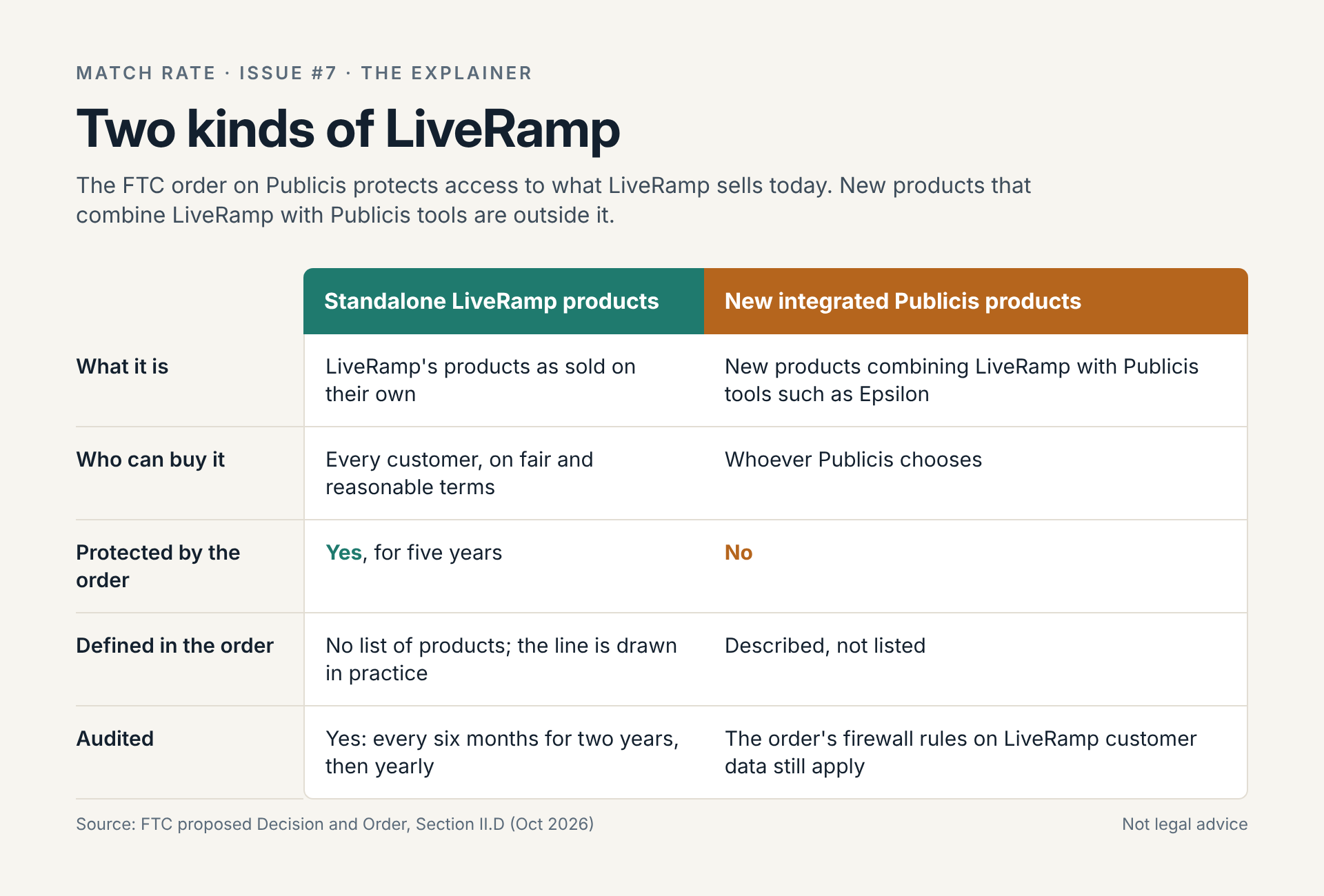
Why it matters this week. Over five years, the products that matter most may be the new ones. If you're a non-Publicis buyer, your access is guaranteed to what exists, not to what comes next.
Three questions to ask LiveRamp now:
- Which of the products we use count as standalone under the order?
- If a feature we need ships only in an integrated Publicis product, how will we hear about it?
- Can we request the customer audit the order allows, and what does it cover?
My bias: Semcasting is an independent identity company, so this split works in our favor. The same questions are fair to ask of us about our own roadmap and ownership.
A question worth asking this week
"Is an independent identity provider safer than one owned by a holding company?"
Not automatically. Ownership is one risk. Others matter as much: whether the provider can be acquired next year, how its data is sourced and consented, how accurate its matches are, and whether you can leave without losing your setup.
What ownership changes is incentives. A provider owned by a media buyer has a reason to make its own agency's clients' experience better. An independent one has a reason to keep every buyer. Neither is a guarantee. The FTC order is useful because it makes one company's obligations specific and auditable. Ask any identity partner, independent or not, for the same: in writing, what they will and won't do with your data, and how you would check.
That's Issue #7. If your agency has told you what it's doing about LiveRamp, or you've moved search budget and measured the result, hit reply. I'd like to hear how it's going.
Geetha
Match Rate is written by Geetha Neelakantiah, SVP Business Development, Marketing & Operations at Semcasting. The views are my own. Sections labeled "The Semcasting view" or "My bias" reflect my company's perspective. Nothing here is legal advice.